Wednesday, 27 May 2015

Pop-up!


This week we entered the world of book arts with  pop-up book design. Who doesn't love the delight of opening a great pop-up book?


As Montreal pop-up artist Natalie Draz says "there's no such thing as a new fold in pop-up design. It's basically all about the remix." With this in mind our pop-up session included two classic pop-up folds: the talk box (aka the mouth fold) and the integrated box fold.


Kids and adults alike love the talk box. Because it's easy to make and because it immediately evokes a snapping mouth. It's a great introductory fold because it gently leads our young paper engineers into "thinking with their hands". For pop-up art, the paper must be coaxed into the form.


Once constructed, the talk box can be modified. Jagged teeth are popular. As are wagging tongues…


A talk box might conceal a secret message for the reader.


Howabout this double embedded talk box a student came up with all on his own?


The integrated box fold is often seen in the form of a square platform.


A whole bunch of them together make excellent skeleton ribs.

Once this fold is mastered it lends itself to experimentation. Integrated boxes can be made at different angles and combined to create interesting structures.


Here's a nested structure in development.


Love the way the green backing paper adds dimensionality to this page.

With these pages made we started to construct a storybook. Why not use a combination of the folds on one page? Some students want to keep adding pages at home…
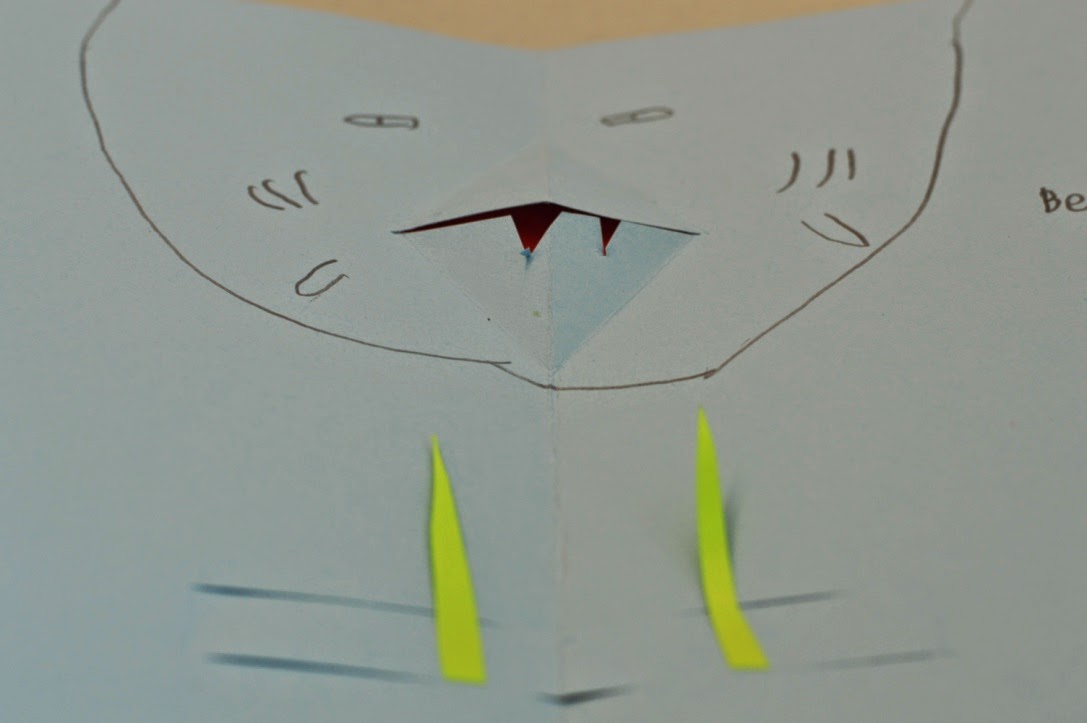

 This student used an integrated box to support delicate waving sea weed.


Here's a book about a mad scientist, who unfortunately blows himself up!


Some kids added text others preferred more of a comic format, but either way storytelling and design narrative started to merge.


Sunday, 17 May 2015

Chain Reaction


This week was all about testing. We challenged the kids to build chain reaction structures - so called Rube-Goldberg machines. A pendulum swings into a ball, which rolls down a slope, which tips a domino train down, which hits a roll of tape, which sends a toy car off the edge of the table, which lands onto a …well you get the idea. There are an infinite range of design possibilities. This class provides a great opportunity to test them.

If we're lucky they work first time. But more likely the design needs a bit of tweaking.


This starter tube needs to on a slope so the marble will have enough momentum to move down the wood steps.


That works. 


Wonder if the dominoes will cascade up these steps?


Maybe the tape roll needs to be a little bit closer to the next ball?
Is this the best spacing and orientation for the dominoes?


Try again…


Multiple transfer points here. Risky, as there are more chances of error too. But also much more entertaining if it works!


I've got to get this to collapse on top of the domino. 


Nice lever idea. Time for some testing….let's see if the force will be big enough?


 Lots of teamwork was in evidence for this class. Testing a chain reaction machine -which auto-triggers with a tiny vibration- requires patience and cooperation. 

There are lots of examples of Rube Goldberg contraptions on the internet. My favourite: kinetic artist, Joseph Herscher and his page turning machine!       

           . 

Wednesday, 6 May 2015

Undercover

A secret criminal ring has infiltrated Givins Shaw Public School. It's necessary for the students to go undercover with a brilliant spy disguise to conceal their identity. Invention Squad visited the Arts Alive event at the school to help them do this.


                                                     Good Hair Day


Moustaches are in.


So are beards.


Who are these people?

Thursday, 30 April 2015

Pickup device

This week we tackle an every day problem: how could we make carrying multiple grocery bags an easier task? More specifically, how do we stop the bags snarling up together and digging into our skin? Is there a better way to distribute the weight? Could we take some of the load off our hands? How could we make the task altogether more fun?


This hand held device nicely distributed the load of four bags around a good firm carrying handle. Clips were used to secure the bags.


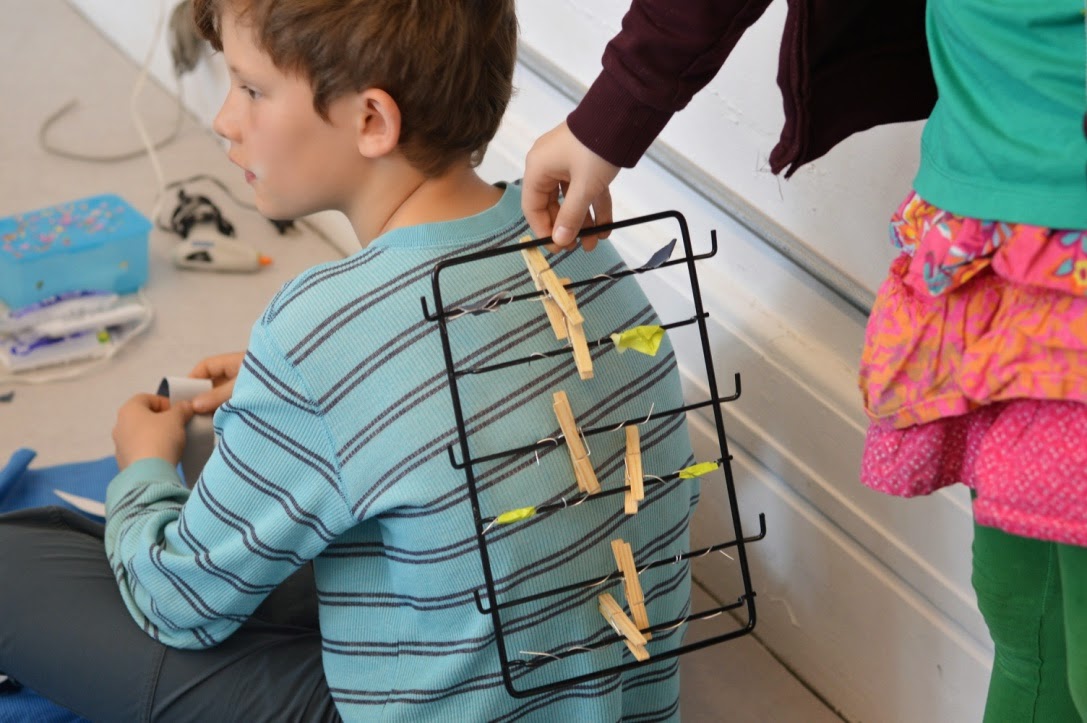
This is the start of a backpack carrier, with lots of firmly secured clips and hooks for the grocery bags.


This hands-free solution is attached around the waist.


Designer testing revealed that it might be useful to leave the buckles flexible (rather than rigid) to allow the user to "squeeze through small spaces".  Good thought. Might want to modify further to prevent the bags from slipping off the rods?


Several of our students decided to update the granny cart and used wheels on their carriers. 


This pickup device is a travelling robot carrier. 


Forget about the bags! What about the bugs? It's time they went for a ride. In this ant transportation system, a whole nest of ants can explore the zig-zag tunnels whilst on the move. Next step adding wheels and a motor…


This design is a carrier with retractable hooks. This inventor went one step further. The carrier can be attached to the wall and the hooks hang down whilst you unpack your groceries. Once done, the hook is mechanically pulled up (she prototyped this with a accordion string design) and pegged flat against the wall.  We liked the multistep thinking here.