Showing posts with label constraints. Show all posts

Tuesday, 27 October 2015

Spooktacular Light Design


This week we made fantastic light designs. We challenged the kids to do this using only foil, pipe cleaners and a hand held torch or a string of fairy lights. By constraining the materials available, we forced them to explore the possibilities and limits of what you can do with foil -squish it, mould it, fold it, fan it, puncture it etc.


When we turned off the lights in the studio, the fun began. There was lots of exploration of the qualities that foil might contribute to the design- whether the light is reflected by it, passing through a space in it or distorted by an edge of it.


This cat alien has devilish red ears and waggling foil legs and is wound round with pumpkin-coloured fairy lights. 


These ghost masks have internal lights shooting out of ghoulish eyes (and blood streams for the top light).


Some of our students made sculptures-moulded with foil-to project interesting shadows -this one's a witch -onto the wall.


Others were entranced by the reflective properties of foil and built a giant space age plane with tiny magical animals flying on the top of the fuselage.


This student made a series of horseshoe shaped ornaments, with candy cane like pipe cleaner stripes, this became a visually appealing garland.


This lantern box made good use of a coloured scaffolding and cast an interesting shadow.


In this team effort, our designers made a large flower with illuminated squirly stamens in the centre and a twining decorated vine. Nice job!


Thursday, 5 February 2015

Life in the trees


One of our challenges this week was to plan and build an animal treehouse. After picking a creature -real or mythical, the kids started off by drafting a plan. This was a 2D bird's eye view or a side view. Every creature needs a good lookout and somewhere to stash their food, so we encouraged the addition of windows, doors, connecting stairs or corridors and furniture to define the different rooms.

                                         Here are some of the ideas:


This dragon den includes a surround view flying dome.


Many of the plans had modular components connected by tunnels. 
These lucky ants have an amusement park on hand.


"Hang-outs" featured prominently on many of the plans. 
This locust house has a hotel add-on for guests. 


This rabbit tree-warren connects to the ground-level burrow and has a nursery area for baby rabbits. 


A multi-level cat treehouse with climb zone, scratch post walkways and a relaxing lounge. 


Alternative sketches for hanging squirrel dens

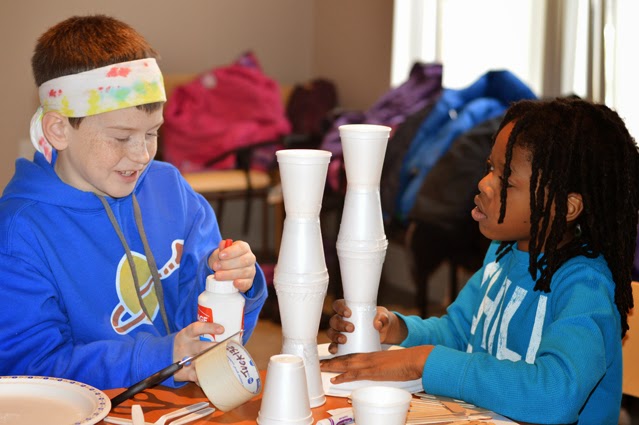
At the end of this landscaping session we challenged the kids to transform their blueprint into a 3D model of their treehouse. Architectural prototyping requires spatial perception, mathematical thinking and basic crafting skills. Offering a limited selection of found materials to build with (in this case picnic ware: plates, cups, forks, spoons and coffee stirrers) makes this modelling task a little trickier. It requires exploration of how the materials connect, flex and balance. As play-doh and tape were involved, also a lot of fun!


Some students enjoyed experimenting with the materials to move beyond their 2D plans :


How high can this squirrel house possibly go? 


This student decided to plan an underwater treehouse. Here's her fish fountain. 
A cascading slide will connect the swim layers.


Ramps and spring-boards featured in this attractive squirrel-drome. Interesting geometry!


Construction team.


Working it out together

Thursday, 27 November 2014

Parapan-Am 2015


With the Parapan-American Games coming to Toronto this summer, we asked our Invention Squad to design a game for teams of blind players and one participant in a wheelchair. In creating a new sport, we're not making an object, we're designing a working system.

In order to better understand the constraints of this task, we had a Q and A with guest participant: John Willis. John is an inclusive designer (meaning he designs with people of all abilities in mind) and is also blind himself. He talked to the kids about what sports are fun for him to play and what things he tries to avoid at all costs (fast moving balls, tall hard obstacles).

With these user constraints in mind, we brain-stormed to come up with a blended game. We had lots of ideas as a group. Elektra and Zachary thought of a flag capture game, where the wheelchair participant has five flags and two teams of non-sighted players try and find the flags, with directions from two sighted guides. We test played this for two rounds.


When users test a game it is really obvious what works and what needs improving. Overall the verdict was that this game was quite fun, but that:
  • The flags need to stick out from the wheelchair all in one place (to avoid the crazy groping)
  • There should be some way of limiting the amount of time a blind person can touch the chair  (same reason as above). Maybe a ref is needed to enforce this?
  • There needs to be a way to slow the wheelchair down -or maybe there should be multiple wheelchair participants (to "confuse it up" some more)
  • The flags could be different textures for the two different teams
  • There might be blind people with flags (should these guys also be able to get flags)?
  • Our guest designer, John pointed out, that we might want to modify the game so that the blind participants have more autonomy i.e. they are experiencing the game through their own senses more. 
Round one of prototyping done. Lots of great design modifications by our young inventors. 


Wednesday, 29 October 2014

Spooktacular Light Design


This week we made fantastic light designs. We challenged the kids to do this using only foil, pipe cleaners and a hand held torch or a string of fairy lights. By constraining the materials available, we forced them to explore the possibilities and limits of what you can do with foil -squish it, mould it, fold it, fan it, puncture it etc.


When we turned off the lights in the studio, the fun began. There was lots of exploration of the qualities that foil might contribute to the design- whether the light is reflected by it, passing through a space in it or distorted by an edge of it.


The pipe-cleaners were sometimes used to sculpt a beautiful illuminated object  (like the wire light sabre at the top) or this intricate fairy garden design below.

Sometimes the interplay between the light and the shadow it cast animated its surroundings. Some of the kids were fascinated by this idea and designed intricate shadow boxes and light projectors.   


One wire sculpture evolved into a carnival  over the course of the class, with a dinosaur, two riders and dangling shapes casting a playful scene onto the wall.  Another, a green bear shadow maker.


This flower-like projection (above) was developed, by moulding the foil onto the face of the torch and experimenting with the effects at different angles.


One design team decided to pursue a Halloween theme.  Here is their iridescent pumpkin parade (left).

It took serious collaboration to come up with this installation!