Showing posts with label load testing. Show all posts

Friday, 26 June 2015

Watercraft

Our final class of this session: designing, building and testing boats.  Lots of decisions to make when making a vessel that's seaworthy and visually interesting. What materials will be buoyant, waterproof and light enough to allow for propulsion through water? What overall shape is streamlined enough, stable and will stay on course?


Testing was an important part of this class.


This bottle provides lots of potential buoyancy….


But a round-bottomed hull and a high centre of gravity was susceptible to rolling -especially in calm water!


A flat-bottomed hull like this pontoon style boat design was far more stable in this situation. 


Some boats had extra floats for added buoyancy.


Some vessels used jet propulsion (with the aid of a balloon) to move through the water. We discovered that this worked best when the design was very light, like this example above.


Other boats were designed for wind power and came equipped with sails and a complex of masts (with a crow's nest up top).


Small streamlined boats (like these speedboat type designs) can move quickly by planing over the water. They are highly manoeuvrable.

Time to test how much load the boats can carry.


This slipper boat could only carry a small load.


Whereas this large very buoyant flat-hulled vessel was like a tanker-almost unsinkable!


Each design had its own story. There is a comfortably furnished army boat, a pirate tugboat and even a torpedo porcupine boat. 

Boats Ahoy!

Wednesday, 3 December 2014

Structures


This week Invention Squad built strong and stable structures. We looked at a variety of designed structures to see whether they were formed of linear (rods, bars, sticks etc.), planar (sheets) or block components.

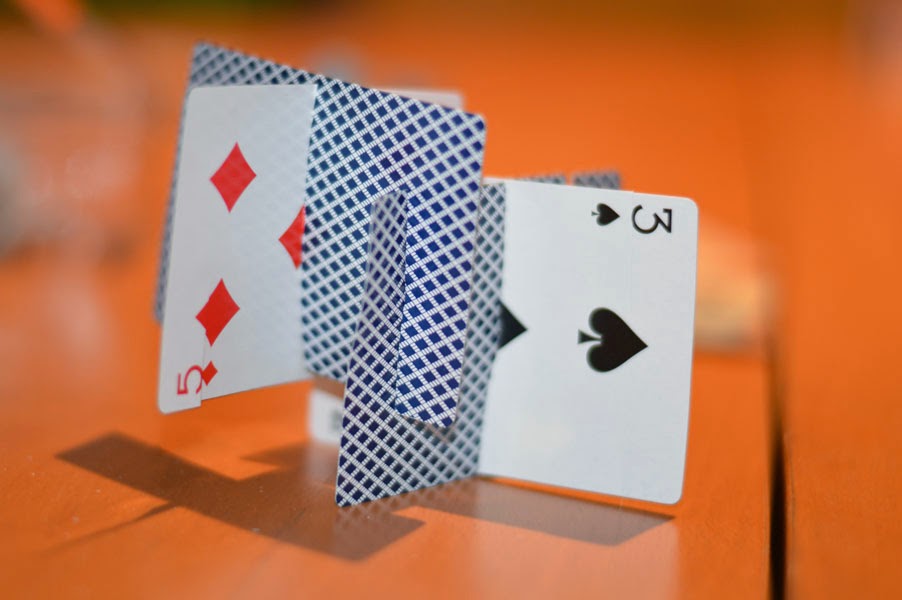
Then we gave the kids a pack of playing cards and a pair of scissors each. Their task was to build any structure they wanted to- tables and chairs, houses and bridges and test them for their load bearing properties. Since we deliberately did not provide any glue or tape, one aspect of this design challenge involves exploring joints.

Here are some simple structures made by card slits that form potential support units for our structures.


These can be used to support a planar sheet made of multiple cards- which creates a (somewhat shakey) table,


or the first storey of a house,


or a beam bridge with two piers…


As everyone knows, the funnest part of building a structure can be demolishing it.  We tested our structures to see if they could support an elephant. This is a chance to observe how compression and tension forces act on a structure:
image taken from http://www.pbs.org/wgbh/buildingbig/bridge/beam_forces.html

It's also an opportunity to spot the weak spots in a structure, as it's collapsing.  The central point of a beam bridge (furthest from the piers) is always the weakest point.  This woven bridge (below) works quite well to add strength to the beam.


Enterprising use of card boxes and some trussing on the piers on this bridge (below).


Whoops! Back to the drawing board.


 How can we make that beam more sturdy? What would make those piers more stable and supportive?