Showing posts with label structures. Show all posts

Wednesday, 3 December 2014

Structures


This week Invention Squad built strong and stable structures. We looked at a variety of designed structures to see whether they were formed of linear (rods, bars, sticks etc.), planar (sheets) or block components.

Then we gave the kids a pack of playing cards and a pair of scissors each. Their task was to build any structure they wanted to- tables and chairs, houses and bridges and test them for their load bearing properties. Since we deliberately did not provide any glue or tape, one aspect of this design challenge involves exploring joints.

Here are some simple structures made by card slits that form potential support units for our structures.


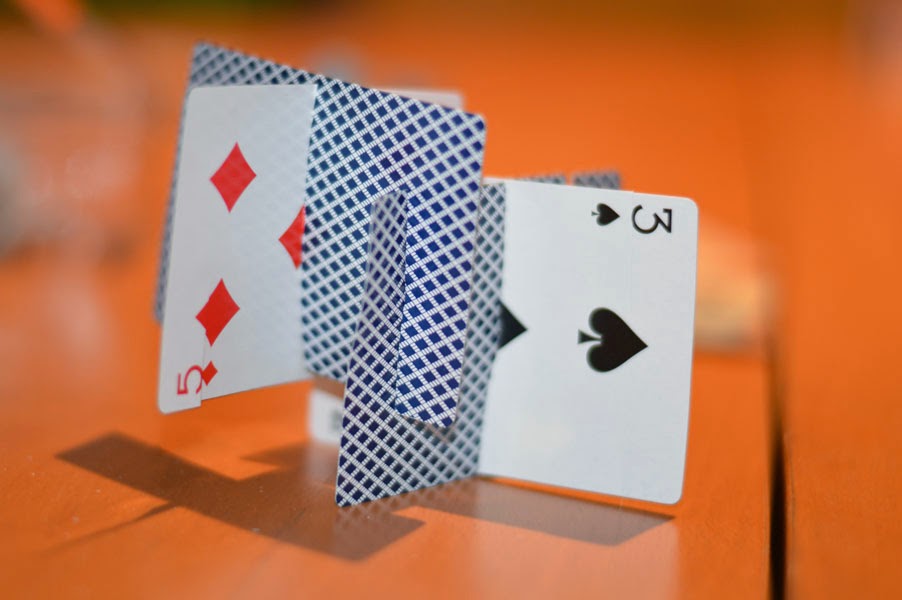

These can be used to support a planar sheet made of multiple cards- which creates a (somewhat shakey) table,


or the first storey of a house,


or a beam bridge with two piers…


As everyone knows, the funnest part of building a structure can be demolishing it.  We tested our structures to see if they could support an elephant. This is a chance to observe how compression and tension forces act on a structure:
image taken from http://www.pbs.org/wgbh/buildingbig/bridge/beam_forces.html

It's also an opportunity to spot the weak spots in a structure, as it's collapsing.  The central point of a beam bridge (furthest from the piers) is always the weakest point.  This woven bridge (below) works quite well to add strength to the beam.


Enterprising use of card boxes and some trussing on the piers on this bridge (below).


Whoops! Back to the drawing board.


 How can we make that beam more sturdy? What would make those piers more stable and supportive?


Friday, 7 November 2014

Design-a-thon 2014

Invention Squad ran this year's Design-a-thon at Niagara St. PS.


A team of talented designers ran hour-long workshops throughout the school to give the grade students a whole day of hands-on challenges. 

In the Fancy Footwear workshop, the kids designed and constructed their own shoes out of paper and glue. Students were asked to incorporate four different methods of creating strength using just these very limited materials. The kids made some amazing footwear- both fancy and functional!


The Critterville workshop challenged kids to build an animal home from picnic wear (plastic cutlery,  foam cups, paper plates, straws and coffee stirrers). The students explored how to join materials in novel ways to shape and stabilize their structure. We asked them to do this with no glue and as little tape as possible. This encouraged them to think about strength, balance and material manipulation-all critical  qualities for architects and builders. Despite the fact that kids love tape, some of them rose to this engineering puzzle! 


In Logomania, the students learnt some of the elements of graphic design and branding. They came up with vibrant pen drawings of logos for the Toronto Zoo, the Design-a-thon itself and Invention Squad.


In the Mouse House workshop students explored paper engineering to make pop-up houses. Many of them enjoyed painting their pictures in exuberant colours.


Robot Design was a very free-form workshop run by Walnut Studios and a couple of volunteer OCAD students. Students animated found materials to create a whole range of charming robots.


In the Skyscrapers workshop the design challenge was to build the tallest structure possible out of construction paper. Some of the groups formed teams and turned this into a competition. Students were introduced to concepts of mass, tension and compression and how to mitigate these using trussing and cross-bracing.  


Invention Squad would like to thank all the fabulous designers, volunteers and school staff who made this fun event possible!!

Monday, 4 March 2013

Upcycled Furniture


Invention Squad ran an all day workshop for Grade 5 Clinton Street students. The brief was for teams of kids to work together and design, model and then build either a table or a chair. Constructing furniture -especially chairs-is one of our favourite challenges because it requires a delicate balance between ergonomics (a comfortable fit for the body) and artistry (a design that looks great).


In our workshop, students are given a chance to move from a 2D sketch to a small construction paper model and then scale it up to create a full size piece of furniture. This open-ended prototyping exercise requires thought about how to make a structure strong and stable and yet comfortable at the same time.


Some of the tables were attractive as well as functional.