Showing posts with label engineering. Show all posts

Thursday, 3 December 2015

Ready, set, ZIP!

This Fall we've played, picnicked, illuminated, streetscaped, posed, modelled, chored and shopped. And finally, we zip into the Holidays!


In our final sessions there were three small design challenges. We built mini zip-mobiles, zip carriers and zip target droppers.


Time to build a zip-mobile. The challenge: make a sturdy structure that will fly down the zip line in less than four seconds using a paperclip, 2 straws, 2 sticks, 2 washers, tape and scissors. To make a device that zips, consider what arrangement will avoid too much friction or drag and think about how your centre of gravity will affect the flight.


Most of the students easily figure out which material should be in contact with the zip line so that the zip-mobile slides quickly. 


This zip-mobile uses the sticks horizontally almost like wings. The design is symmetrical around the central attachment point which minimizes rotation.


Durability becomes an issue for this designer who wants to build a transporter for her stuffies at home. How can I make something really strong from such delicate materials? 


The second challenge: now modify your zip-mobile to make a zip carrier that will transport a ping-pong ball down the zip line. You are given a cup as additional material. 


Our third challenge was a complex design problem. The students are asked to modify their zip carrier to transport a marble down the line and to drop the marble on a target part way down. This has to be done without touching the carrier directly. There are several ways to tackle this challenge, but all involve some serious lateral thinking!


One team tries a remote string release mid flight. In multiple test runs they discover that the release needs to be before the cup is above the target. This helps because the marble is already moving forward along the zip line and moves in a curved trajectory (not a direct line down) once it is released from the cup.


Some of our young designers came up with a solution where the carrier cup is tipped as it smashes into a barricade. After some testing it becomes apparent that it's hard to get reliable accuracy when the cup is stopped at top speed.  The marble usually comes flying out at random sides, occasionally hitting your friends! Time to rethink the prototype…


Maybe it's better to release the ball from a trap door in the cup rather than using a tipping mechanism?
After some experiments with vibrating the carrier mid flight, one group decides to stop the carrier and then pull out a lower release pin (without touching the cup). Ambitious plan.


And finally, it's race time. Which designs move faster and why? How does their shape and weight affect their speed? And how do friction and drag slow them down? But most of all, why can't you tell that was not a tie!


            Thanks kids, for a creative and lively Fall session.  Hope to see you in 2016.

Wednesday, 3 December 2014

Structures


This week Invention Squad built strong and stable structures. We looked at a variety of designed structures to see whether they were formed of linear (rods, bars, sticks etc.), planar (sheets) or block components.

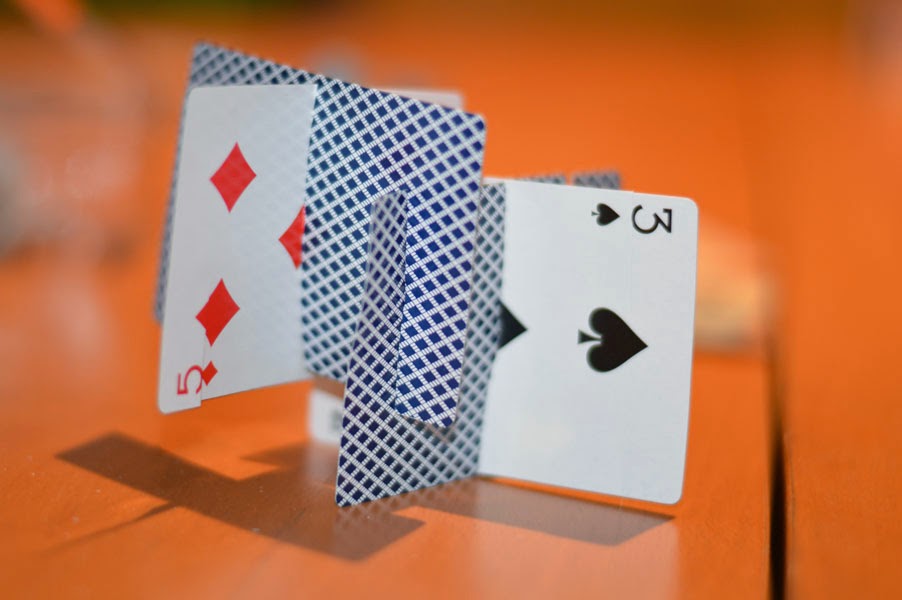
Then we gave the kids a pack of playing cards and a pair of scissors each. Their task was to build any structure they wanted to- tables and chairs, houses and bridges and test them for their load bearing properties. Since we deliberately did not provide any glue or tape, one aspect of this design challenge involves exploring joints.

Here are some simple structures made by card slits that form potential support units for our structures.


These can be used to support a planar sheet made of multiple cards- which creates a (somewhat shakey) table,


or the first storey of a house,


or a beam bridge with two piers…


As everyone knows, the funnest part of building a structure can be demolishing it.  We tested our structures to see if they could support an elephant. This is a chance to observe how compression and tension forces act on a structure:
image taken from http://www.pbs.org/wgbh/buildingbig/bridge/beam_forces.html

It's also an opportunity to spot the weak spots in a structure, as it's collapsing.  The central point of a beam bridge (furthest from the piers) is always the weakest point.  This woven bridge (below) works quite well to add strength to the beam.


Enterprising use of card boxes and some trussing on the piers on this bridge (below).


Whoops! Back to the drawing board.


 How can we make that beam more sturdy? What would make those piers more stable and supportive?


Friday, 7 November 2014

Design-a-thon 2014

Invention Squad ran this year's Design-a-thon at Niagara St. PS.


A team of talented designers ran hour-long workshops throughout the school to give the grade students a whole day of hands-on challenges. 

In the Fancy Footwear workshop, the kids designed and constructed their own shoes out of paper and glue. Students were asked to incorporate four different methods of creating strength using just these very limited materials. The kids made some amazing footwear- both fancy and functional!


The Critterville workshop challenged kids to build an animal home from picnic wear (plastic cutlery,  foam cups, paper plates, straws and coffee stirrers). The students explored how to join materials in novel ways to shape and stabilize their structure. We asked them to do this with no glue and as little tape as possible. This encouraged them to think about strength, balance and material manipulation-all critical  qualities for architects and builders. Despite the fact that kids love tape, some of them rose to this engineering puzzle! 


In Logomania, the students learnt some of the elements of graphic design and branding. They came up with vibrant pen drawings of logos for the Toronto Zoo, the Design-a-thon itself and Invention Squad.


In the Mouse House workshop students explored paper engineering to make pop-up houses. Many of them enjoyed painting their pictures in exuberant colours.


Robot Design was a very free-form workshop run by Walnut Studios and a couple of volunteer OCAD students. Students animated found materials to create a whole range of charming robots.


In the Skyscrapers workshop the design challenge was to build the tallest structure possible out of construction paper. Some of the groups formed teams and turned this into a competition. Students were introduced to concepts of mass, tension and compression and how to mitigate these using trussing and cross-bracing.  


Invention Squad would like to thank all the fabulous designers, volunteers and school staff who made this fun event possible!!

Thursday, 6 November 2014

Evil Geniuses

This week the design challenge was to build a contraption that can fling a boulder across the room.

from http://silverhawkauthor.com/book-siegecraft-no-fortress-impregnable_279.html

The Grade 5 and 6 students worked on constructing siege catapults (Roman Mangonel style). These required a very sturdy base and vertical support-no trivial matter when all you have to use is craft sticks clothes pegs and tape. The throwing arm was levered to the base with a bull clip fulcrum and stretched back with an elastic band. Pull the arm back and fling! Launch your foil boulder into the air.


Some of our budding engineers managed to improve their catapults-Elizabeth suggested more robust materials like wood and nails, Joseph and Jabeez worked out how to truss their structure. Zachary modified his catapult by adding a pull back tab and noticed that the angle of release and the size of the boulder affects how high and far it goes.


To build a prototype, test it, evaluate and improve it, is part of the design spiral we are teaching the kids.  In this workshop, the kids followed a set design plan, but then refined their catapults to improve their function.

from http://discoverdesign.org/design/process

Meantime the Grade 3 and 4 kids were evil geniuses in revolt. They decided to modify balloon slingshots into their own more exciting creations. Reinventing the workshop on the spot. There was a decadent looking "hugging slingshot" designed by Elektra, which spurred on the other kids to make crossbows and various catapult accoutrements.